



Melanopsin Receptor
OPN4
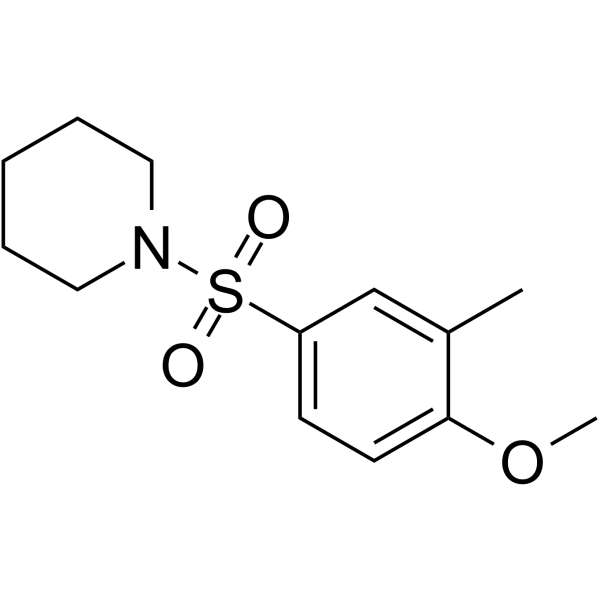
Melanopsin (OPN4) is a G protein-coupled photopigment that enables intrinsically photosensitive retinal ganglion cells (ipRGCs) to sense ambient light and participate in the regulation of physiological, behavioral, perceptual, and non-image-forming visual responses[1]. Regarding phototransduction mechanisms, melanopsin signaling in M1-type ipRGCs relies on PLCβ4, while TRPC6/TRPC7 channels mediate their intrinsic light responses, establishing a signaling mechanism akin to that of invertebrate microvillar photoreceptors[2]. Through this endogenous photosensory system, ipRGCs contribute to circadian photo-entrainment and the pupillary light reflex; additionally, melanopsin signaling in M4-type ipRGCs facilitates contrast detection by modulating intrinsic cellular excitability[1][3]. Responses to melanopsin signaling vary across ipRGC subtypes: melanopsin increases the excitability of M4-type cells by closing potassium leak channels, whereas M1-type cells exhibit reduced excitability during melanopsin-mediated phototransduction[3]. Compared to rod and cone photoreceptors, ipRGCs exhibit more sustained intrinsic light responses—a kinetic characteristic consistent with the slower temporal dynamics of non-image-forming visual functions[5]. In M1-type ipRGCs, alternative splicing generates two melanopsin isoforms, OPN4S and OPN4L; when these are individually re-expressed in *Opn4*-deficient mice, no significant differences are observed in their intrinsic responses to dim flashes of light[5]. Research into disease associations indicates that the melanopsin pathway is linked to migraine-associated photophobia—a response involving both melanopsin and cone-driven luminance pathways—with migraine patients exhibiting lower photophobia thresholds and enhanced melanopsin-mediated post-illumination pupillary responses[4]. In experimental pharmacology, sulfonamide-based Opsinamides can selectively and reversibly inhibit melanopsin-dependent pupillary and light-avoidance responses by competing with retinal for binding to melanopsin, without affecting rod- or cone-mediated responses; thus, they can be used to study melanopsin-dependent light responses[6].
References:
- [1]. Do MTH. Melanopsin and the intrinsically photosensitive retinal ganglion cells: biophysics to behavior. Neuron. 2019;104(2):205-226.
- [2]. Xue T, et al. Melanopsin signalling in mammalian iris and retina. Nature. 2011;479(7371):67-73. [Content Brief]
- [3]. Sonoda T, et al. Melanopsin phototransduction is repurposed by ipRGC subtypes to shape the function of distinct visual circuits. Neuron. 2018;99(4):754-767.e4.
- [4]. Zele AJ, et al. Melanopsin hypersensitivity dominates interictal photophobia in migraine. Cephalalgia. 2021;41(2):217-226.
- [5]. Sheng Y, et al. Molecular determinants of response kinetics of mouse M1 intrinsically-photosensitive retinal ganglion cells. Sci Rep. 2021;11(1):23424.
- [6]. Jones KA, et al. Small-molecule antagonists of melanopsin-mediated phototransduction. Nat Chem Biol. 2013;9(10):630-635. [Content Brief]
All Product Categories
-
Melanopsin Receptor Related Products (2)
Related Products (2)

-
AA41612
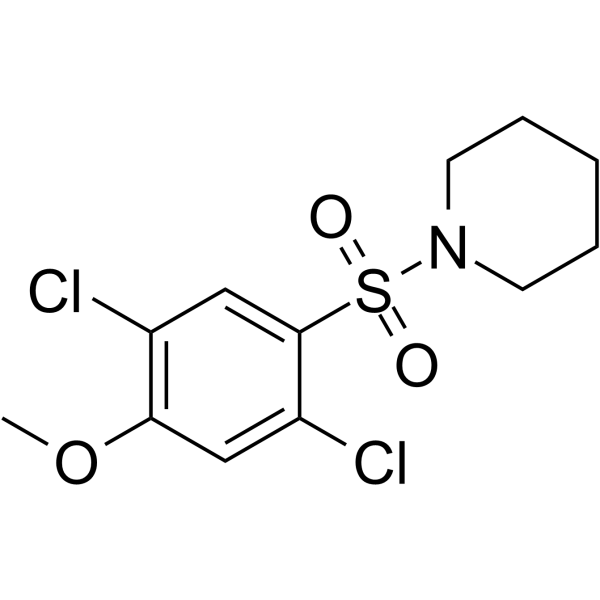 0 ImagesAA41612 is a melanopsin (Opn4) inhibitor with an IC50 of 15.8 nM, a Ki of 0.43 nM, and a Kd of 0.28 nM. AA41612 competes with retinal for binding to melanopsin, blocks melanopsin activation, and inhibits melanopsin-mediated phototransduction processes without affecting rod- and cone-mediated responses. AA41612 attenuates light-induced melanopsin photocurrents, reduces light-induced cytoplasmic calcium elevation, and weakens high-irradiance pupillary light reflex in mice with induced classical photoreceptor degeneration. AA41612 can be used in studies related to migraine and photophobia.



